The set up: bird scarers and auto-jiggers onboard Unity
By Kirsty Bradley, Cefas Fisheries Scientist
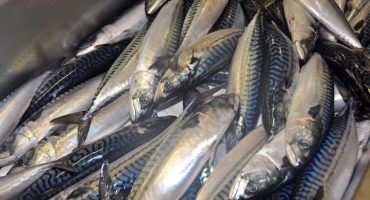
As the fish species with the highest annual landings in the UK by both volume and value, Atlantic mackerel (Scomber scombrus) is an important commercial species. Better understanding of the stock is paramount to ensure mackerel remain a staple in our waters and on our dinner plates.
Many data inputs help improve the way fish stocks can be understood and sustainably fished. Stock assessments need to explore stock dynamics such as mortality, stock size and movement. To understand how a whole fish stock behaves, we first need to identify how large numbers of individuals behave over time, and one approach to identify individual fish is using tags.
At present, the UK and Norway are actively tagging Atlantic mackerel. The Institute of Marine Research, Norway (IMR) have been tagging mackerel since 1968. In 2011, they established a new approach using Radio Frequency Identification (RFID) technology, developing an automated detection infrastructure with cooperation and involvement of the international pelagic industry.
Five countries have registered detection stations, and the UK large-scale pelagic processing factories have all been equipped with tag detectors funded by the Scottish Pelagic Sustainability Group and the Scottish Marine Directorate.

So how does it work?
It’s likely you have used RFID technology in your day-to-day life…it’s the same technology that you use for accessing hotel rooms or office buildings using a plastic ID card. During this process the detector provides enough energy to the battery-free coil within the card to read a unique number and “bleep”, the door opens for you. RFID tags in mackerel work under the same principle, but the coil is encased in a small glass bead. This gives the fish a unique ID number allowing us to identify individuals in the stock, once captured by the pelagic fleet.
We can apply the common phrase “getting from A to B” to mackerel in this context. When trained scientists release tagged fish during specialist sea trips / surveys, the ID number and release location are recorded, giving us “point A”. When a tagged fish is caught, the internal tag is automatically detected in pelagic catches landed to processing factories with installed detectors. To get “point B”, the fishing industry provides recapture locations, by linking the landings with haul locations. So, in simple terms, if we know how many tagged mackerel got to point B we get insight into mortality, if we combine that with how much of the catch was scanned, we can study stock size. Finally, if we can work out geographical locations for point A and point B, we can explore movement. All this information is supplied to the international database by many key contributors across industry including operations and data quality managers who work closely with scientists, to monitor and maintain scanners and provide additional data.
RFID tagged fish are released by IMR each Spring off the West coast of Scotland, and in 2023, the UK joined the effort by launching a survey named “MAKTAG”, tagging mackerel onboard a chartered fishing vessel, in an important area for the UK mackerel fleet, the North Sea.
Mackerel tagging is a streamlined process: both UK and Norway use the same method to allow integration into the international database used in stock assessment. Chartered fishing vessels have an onboard set up that includes mechanised fishing lines, “auto-jiggers”, i.e. they can be set to drop a certain depth, before being reeled in, all at the touch of a button. Auto-jiggers are rigged with barbless hooks and the line passes above a fish trough, to transfer mackerel to scientists when removed from the hook. Captured fish are transferred to holding tanks where they are netted and tagged by a trained scientific team, using a spring-loaded needle, always ensuring fish welfare. Much like a well-timed pitstop: the needle is cleaned, the tag ID number is read, the fish is held, the length is recorded, the tag is inserted, and the fish is released…all in about 5-10 seconds!

MAKTAG is run by the Centre for Environment Fisheries and Aquaculture Science (Cefas), funded by the UK government’s Department for Environment, Food and Rural Affairs (Defra). Cefas chartered the Fraserburgh registered fishing vessel Unity as our ‘survey vessel’. The enthusiasm and interest from our skipper Dave Bellany, has helped make the trips successful. But why get involved in releasing mackerel instead of just catching them?
“Unity got involved in MAKTAG because it sounded like an interesting survey and a few of us had previously spoken about going jigging for mackerel. Turns out getting mackerel on all your jigging hooks is just as exciting as catching a full bag when trawling. There’s also a bit of competition between the stations which adds to the excitement. This leads to a fair bit of camaraderie between the crew and the scientists which is good to see. This led to a good bit of input from both crew and scientists in adjusting the set ups and trying to get the most out of the project. Participation in the project has also been quite interesting and adding to the available data on the stock hopefully increases the sustainability going forward.”

MAKTAG has released 10,986 tags so far in the North Sea, with 500 returns/detections with “point B” locations so far (March 2025). Once information is recorded for a large number of individuals across time and space, it’s possible to use the combined data to improve how the stock is assessed.
Mackerel tagging data contributes important building blocks to our foundation of knowledge that underpins our understanding of the stock. Continued international and industry collaboration and refinement of MAKTAG means the potential for increasing the impact and benefit of this work in future years is substantial. We hope to set up MAKTAG as an annual survey with a long positive legacy, continuing to actively contribute to a valuable data stream, supporting the sustainable future of Atlantic Mackerel.
If you are still curious you can explore online resources… To see details of release and recaptures including international factory locations, explore the international interactive map at www.smartfishmap.hi.no or for updates and information/videos specific to the UK see www.cefas.co.uk/maktag. Thank you to everyone involved, both on land and at sea.